
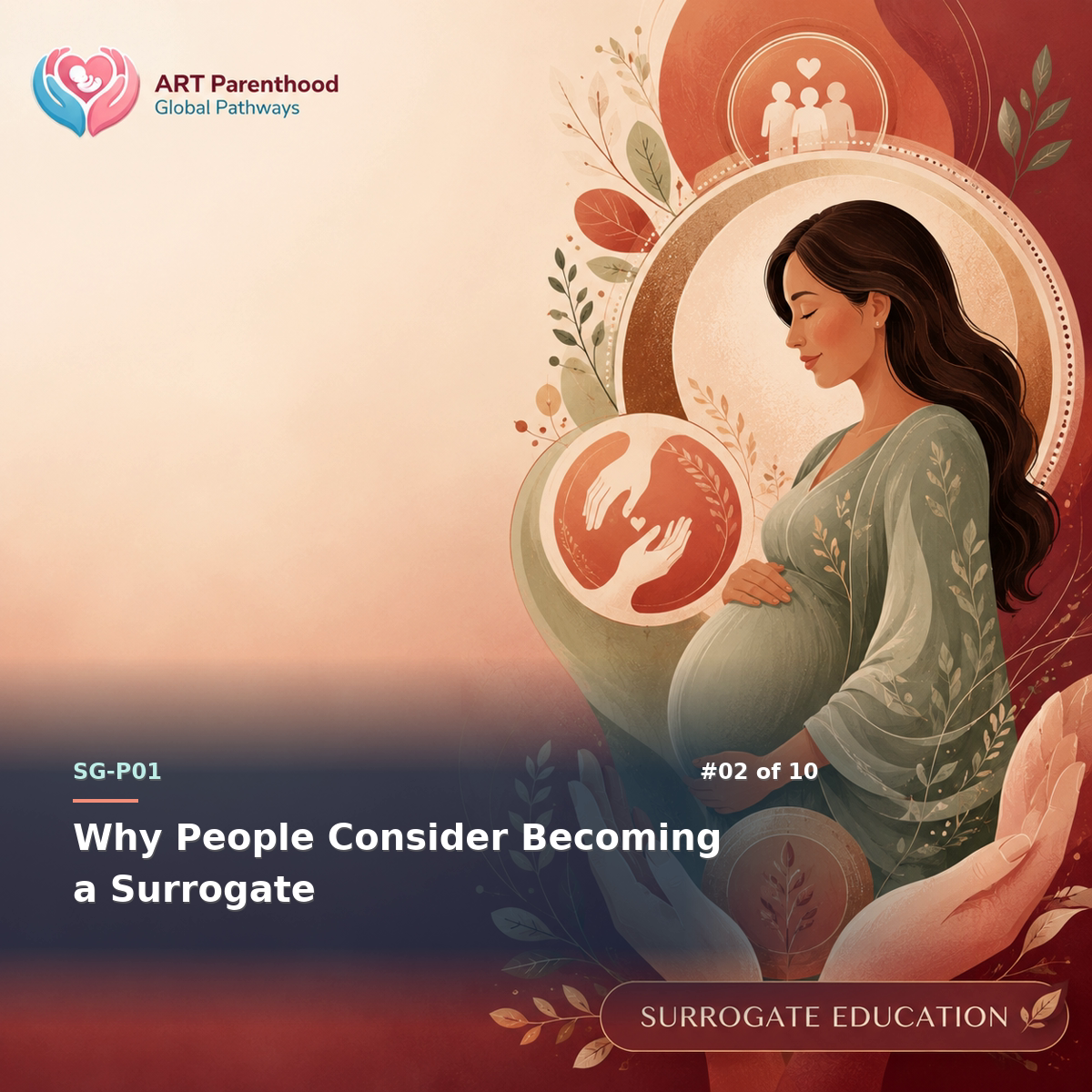
SG-LP01-02 · SG-LP01
People reach surrogacy through a mix of emotion and practicality. A responsible decision honors both. If someone feels called to help, that feeling still has to sit beside the realities of health, recovery, family life, privacy, legal protection, and the emotional weight of carrying a pregnancy for someone else.
Visual lesson summary
Review the lesson as a carousel.
Swipe or scroll through the key ideas, then continue with the detailed guidance below.
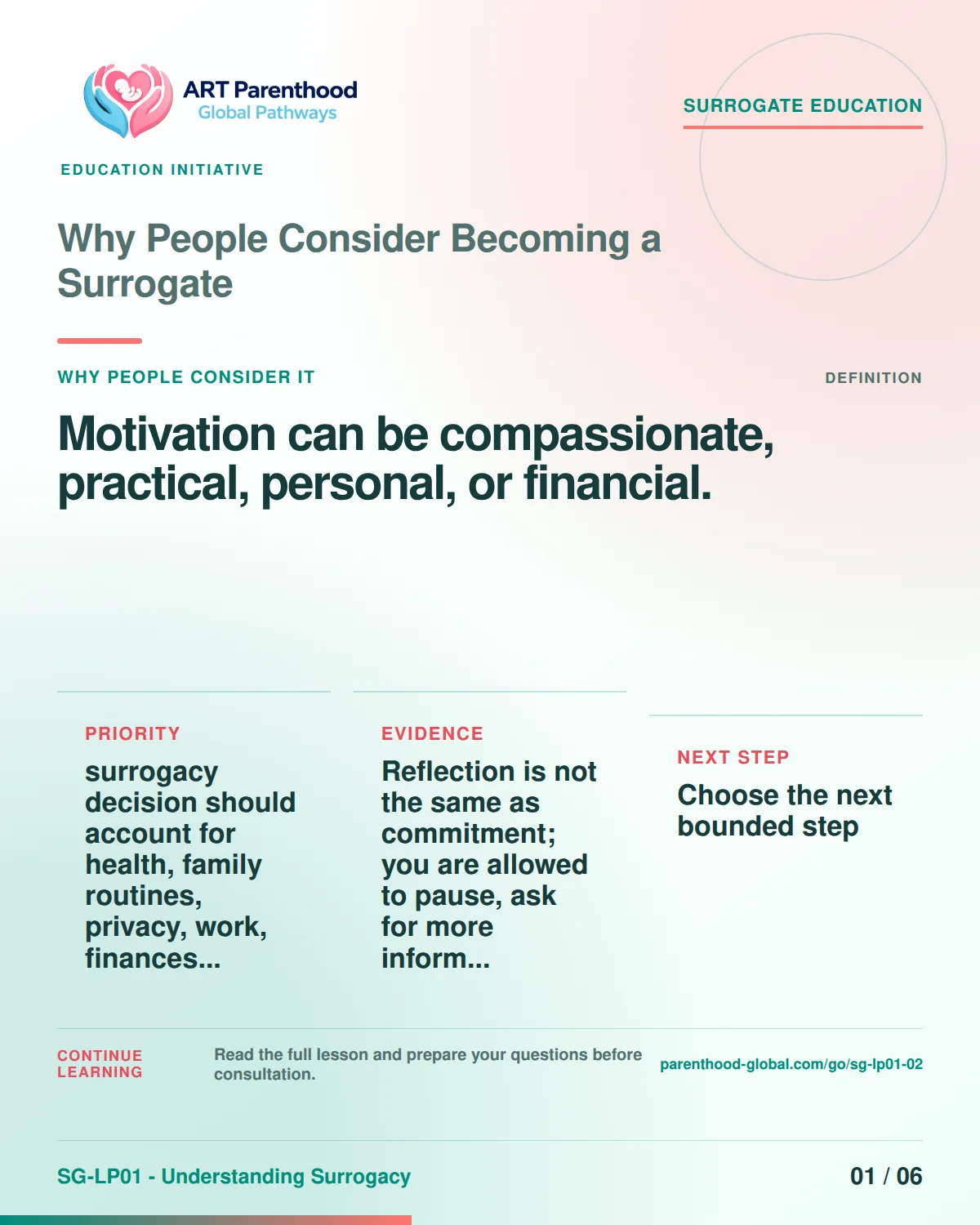
01 / 06Why people consider it 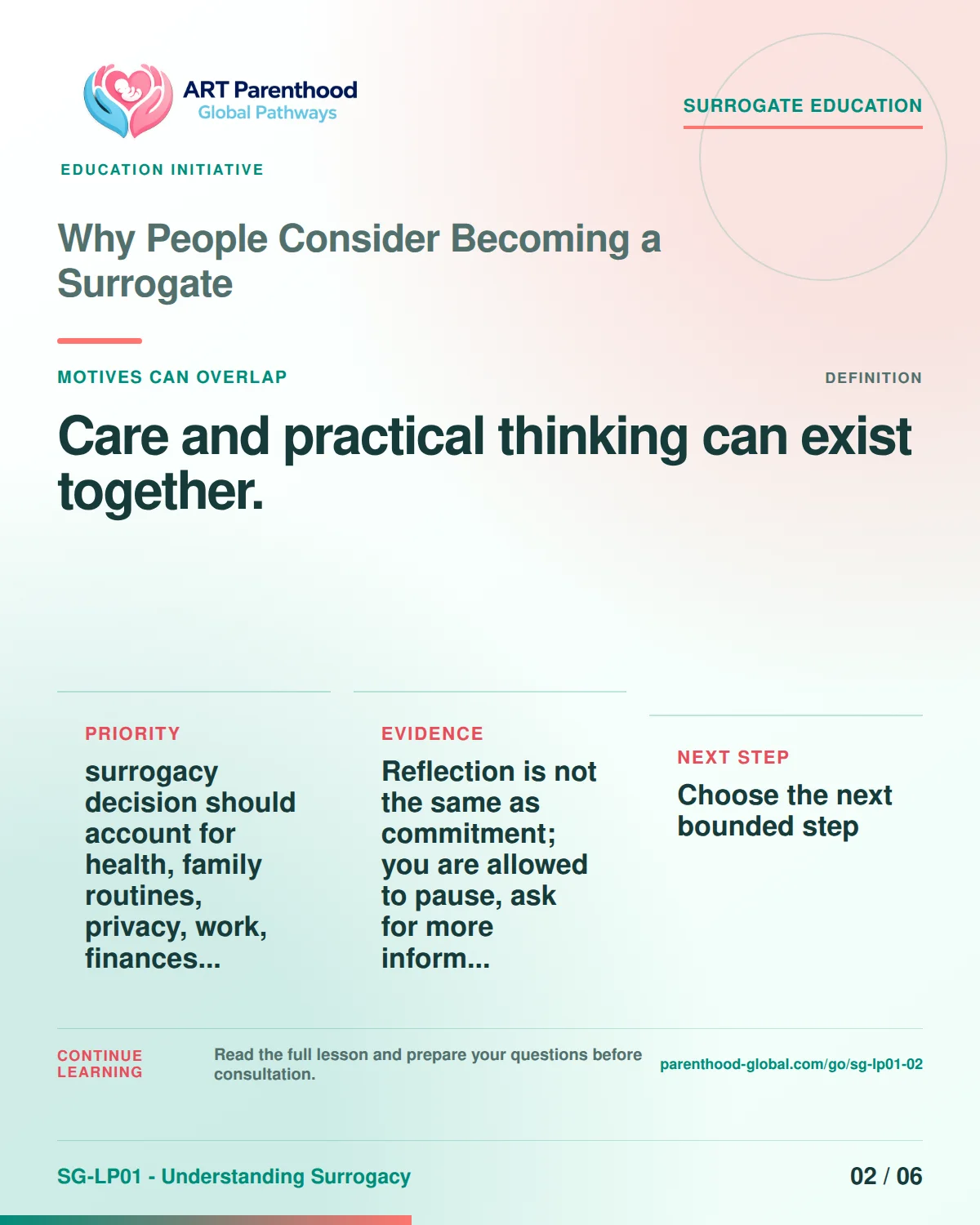
02 / 06Motives can overlap 
03 / 06Look beyond the reason 
04 / 06Pressure is a warning sign 
05 / 06Support matters 
06 / 06Keep reflecting
Motivation is only the starting point
It is common to be drawn to surrogacy for more than one reason. Compassion may be part of it. A positive pregnancy history may matter. Practical planning, compensation, or a wish to use a meaningful life experience in a helpful way can also be part of the picture. None of those reasons is automatically wrong, but none of them should be treated as the whole story.
The more important question is whether your motivation survives honest review. If you imagine the day-to-day work of surrogacy, do the reasons still feel grounded, voluntary, and sustainable? That is the question that should guide the next step.
- Mixed motivation is normal.
- A reason can be meaningful without being sufficient on its own.
- Reflection should happen before screening or matching creates pressure.
What this means for a prospective surrogate
A surrogacy decision can affect sleep, appointments, childcare, travel, work schedules, household routines, intimacy, and privacy. It can also affect how you feel about your body and your relationships over time. Because of that, it is worth asking whether you have enough support for the season of life you are in right now.
This is also the point to think about what kind of communication would feel respectful. Some people want more updates and connection, while others need more privacy. Either way, the key is that your boundaries should be discussed before they are tested.
- Ask whether the timing fits your health and family responsibilities.
- Ask how support will work if appointments, recovery, or childcare become difficult.
- Ask whether the people around you understand what the process will require.
A reflection process that protects consent
A useful reflection process is concrete. Write down your reasons, what you are hoping to give, what you are afraid of, and what would make the process a clear no. Review those notes with someone who is not trying to recruit you. If a clinic, agency, or match contact is responding with urgency, that is information too.
The next layer is documentation and support. Medical history, pregnancy history, a support plan, independent legal counsel, counseling intake, and clear consent forms can all help define whether the process is actually manageable. Those materials do not make the choice for you. They help reveal whether your values, circumstances, and the program's expectations are truly aligned.
A respectful process should make room for a slower yes or a thoughtful no. That is the point of education: not to push someone over the line, but to help her understand the line clearly.
- Medical history review can show whether the body and current life circumstances are likely to support the process.
- Psychosocial review can surface pressure, boundaries, and support needs before they become hidden problems.
- Independent legal counsel helps confirm that the decision is yours and that obligations are clear before any signed commitment.
When to pause instead of push
Pause if you feel rushed, if anyone treats questions as disloyalty, if you have not had space to talk with your own support people, or if you are still trying to understand what the process would ask of your body and household. These are not small concerns; they are the core of informed consent.
You do not owe a yes because you are kind. Kindness can be part of the reason, but it cannot replace clarity. A responsible decision is one that respects both generosity and self-protection.
For Nerds: Technical Deep Dive
This advanced layer is for readers who want to understand why motivation alone is never enough in a surrogacy pathway. It connects reflective interest to psychosocial screening, legal independence, and support planning, and it explains why a person can be compassionate, capable, and still not be ready.
Why motivation is not a substitute for readiness
The strongest public education about motivation is to treat it as an entry point, not a verdict. A person can genuinely want to help another family and still be a poor fit for the current season of her life. Readiness is a composite of body, schedule, support, finances, privacy, and emotional bandwidth. In practice, programs and clinics are trying to answer a different question from 'Do you have a good reason?': they are asking whether the reason still holds up once the actual medical, legal, and relational labor is visible. That distinction matters because it protects consent. It keeps a caring person from being nudged into overextending herself simply because she can articulate a generous motive. A professional review should therefore probe for over-identification, rescue fantasies, guilt, financial stress, partner pressure, family pressure, and the risk that someone is trying to make a complicated life season feel morally simple. If the answers suggest hesitation, the safest interpretation is not failure; it is information that can prevent harm.
- Compassion does not prove capacity.
- A strong motive can coexist with a poor timing fit.
- Pressure, guilt, or rescue thinking are readiness risks, not character flaws.
Key takeaways
- Motivation can include compassion, practical considerations, and personal values, but it should be examined honestly.
- Surrogacy can affect health, time, work, family routines, privacy, and emotional energy.
- A good process protects reflection, boundaries, and voluntary consent rather than rushing a yes.
FAQ
Is it okay if I have more than one reason?
Yes. Most serious decisions are mixed. What matters is whether the reasons still feel honest and sustainable after you think through the realities.
What if I feel torn?
Feeling torn is a reason to slow down, gather more information, and speak with qualified professionals or trusted support people before deciding.
Does asking questions mean I have to continue?
No. Learning and committing are different steps. You can ask questions, pause, or decide the path is not right for you.