

SG-LP01-01 · SG-LP01
Gestational surrogacy is often introduced as a short definition: carrying a pregnancy for intended parent or parents. That is useful, but it is not enough for someone who is seriously considering whether surrogacy fits her body, family life, values, and risk tolerance. A better first orientation explains how IVF, screening, counselling, legal review, insurance, and personal boundaries all connect before any real commitment is made.
Visual lesson summary
Review the lesson as a carousel.
Swipe or scroll through the key ideas, then continue with the detailed guidance below.
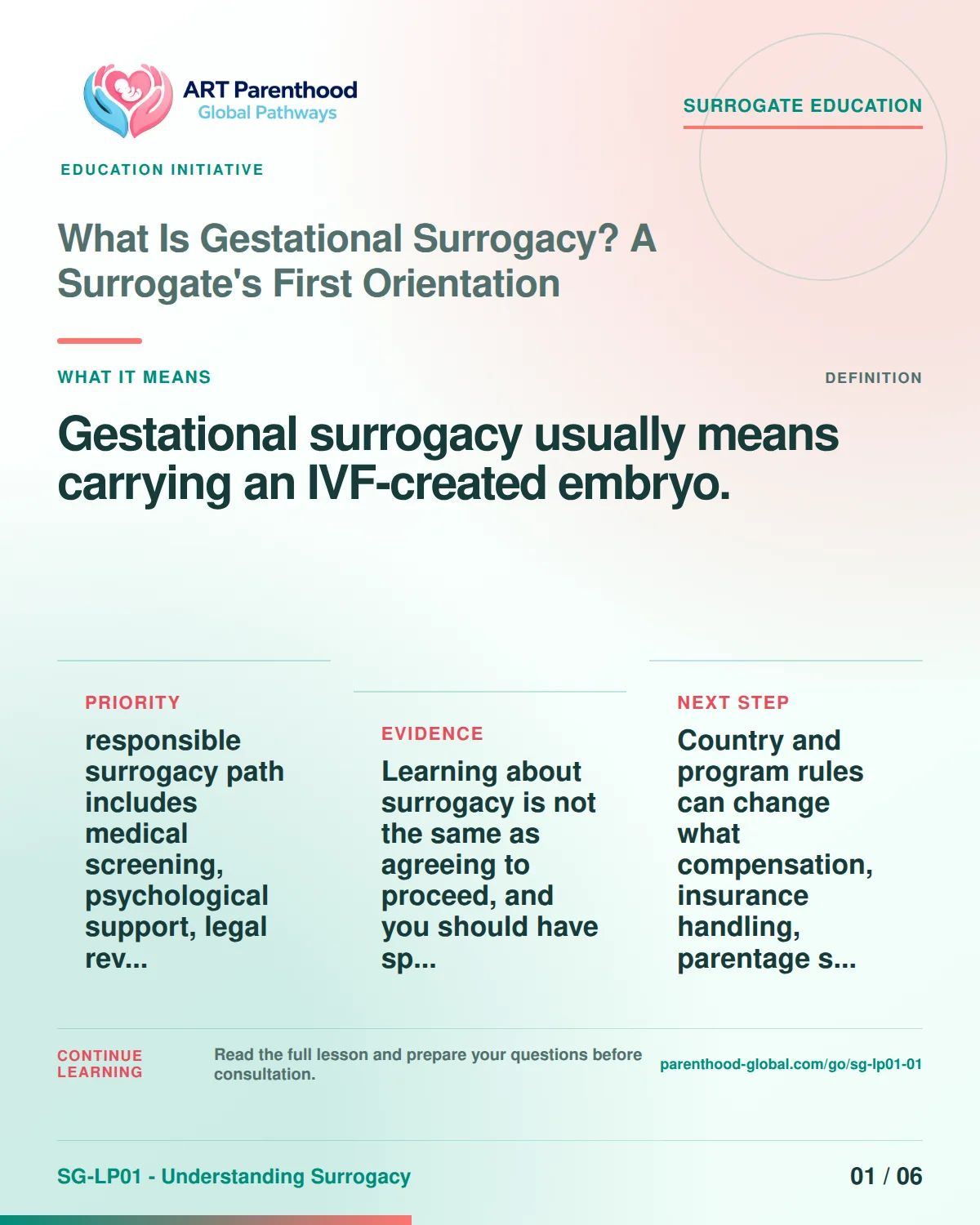
01 / 06What it means 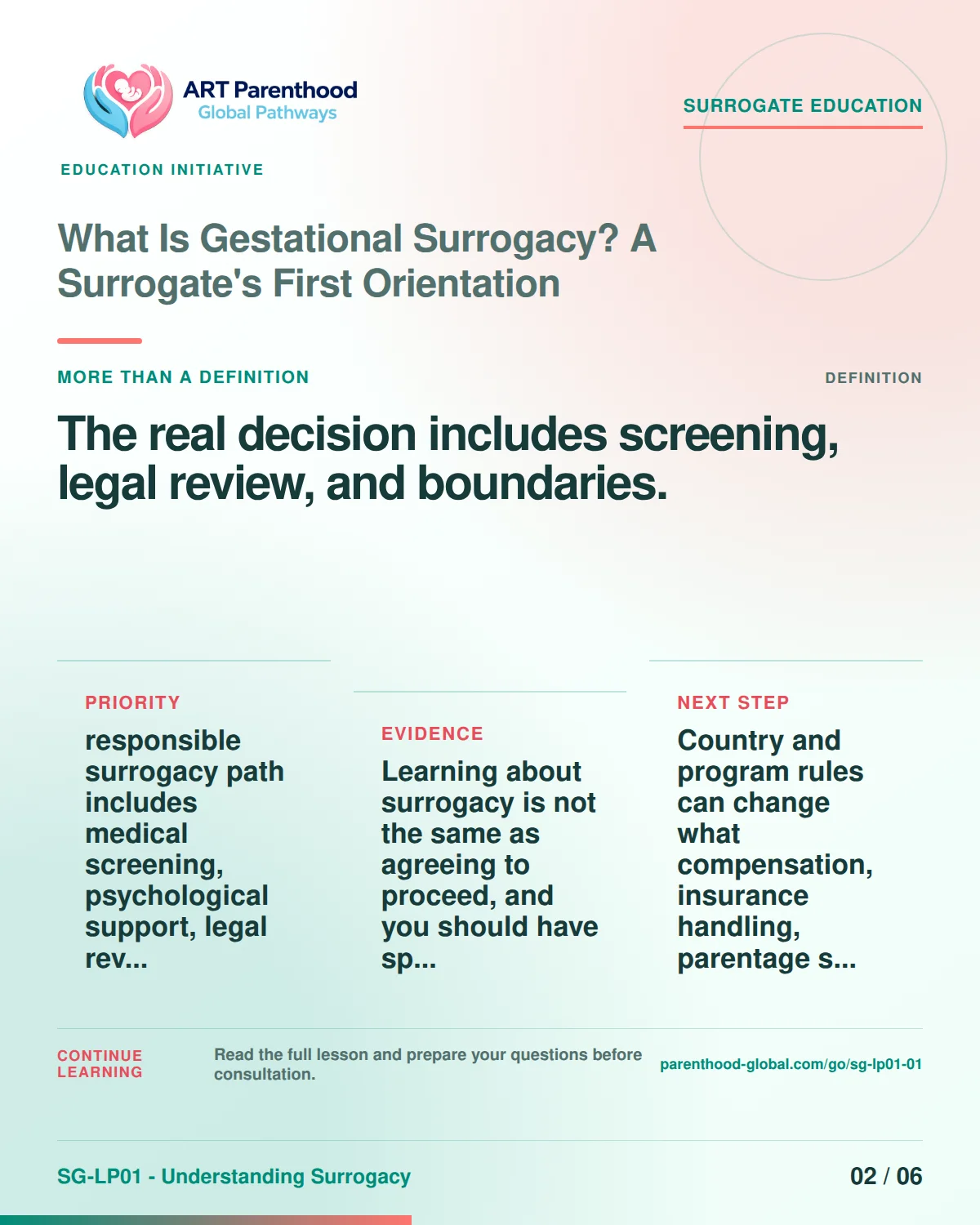
02 / 06More than a definition 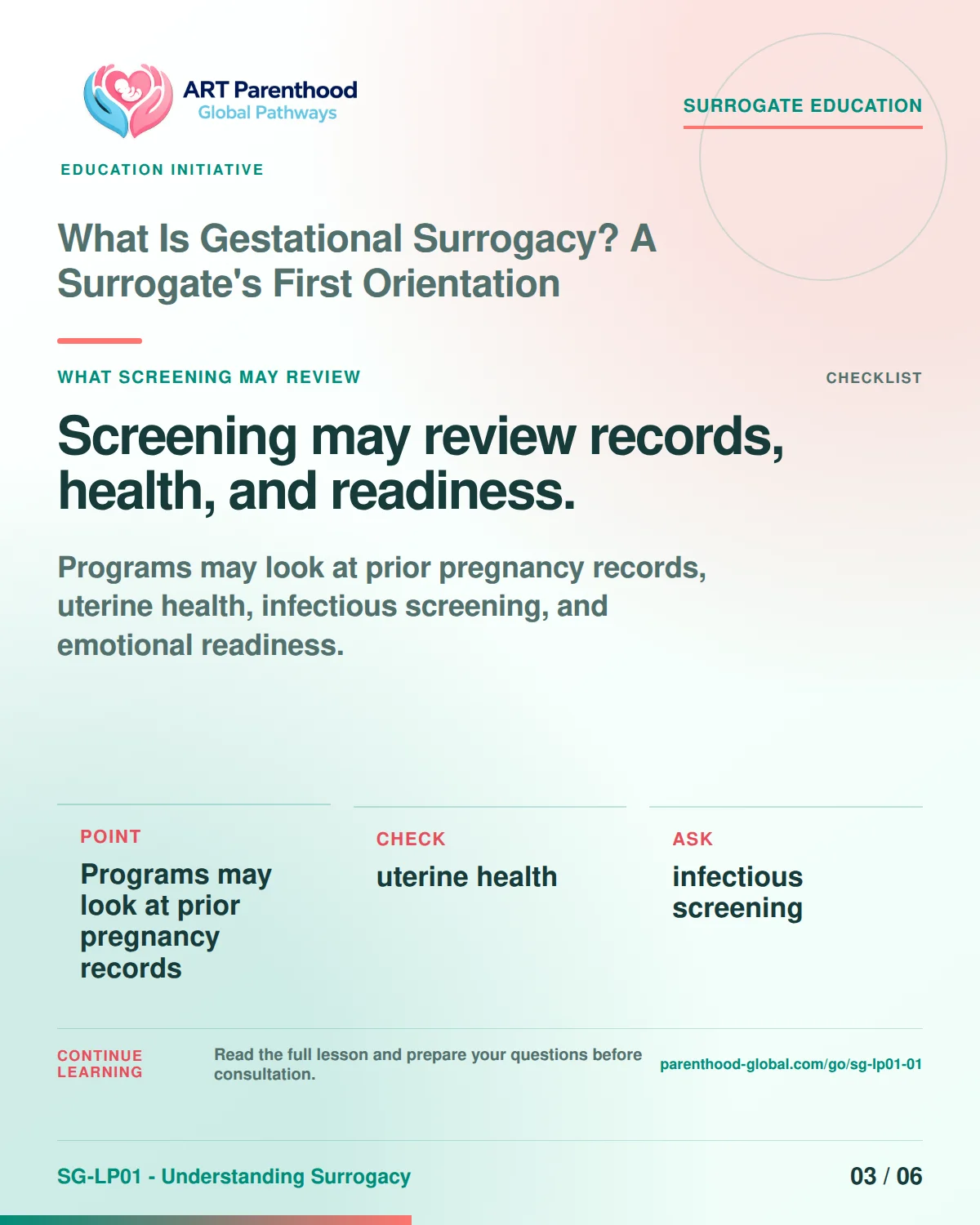
03 / 06What screening may review 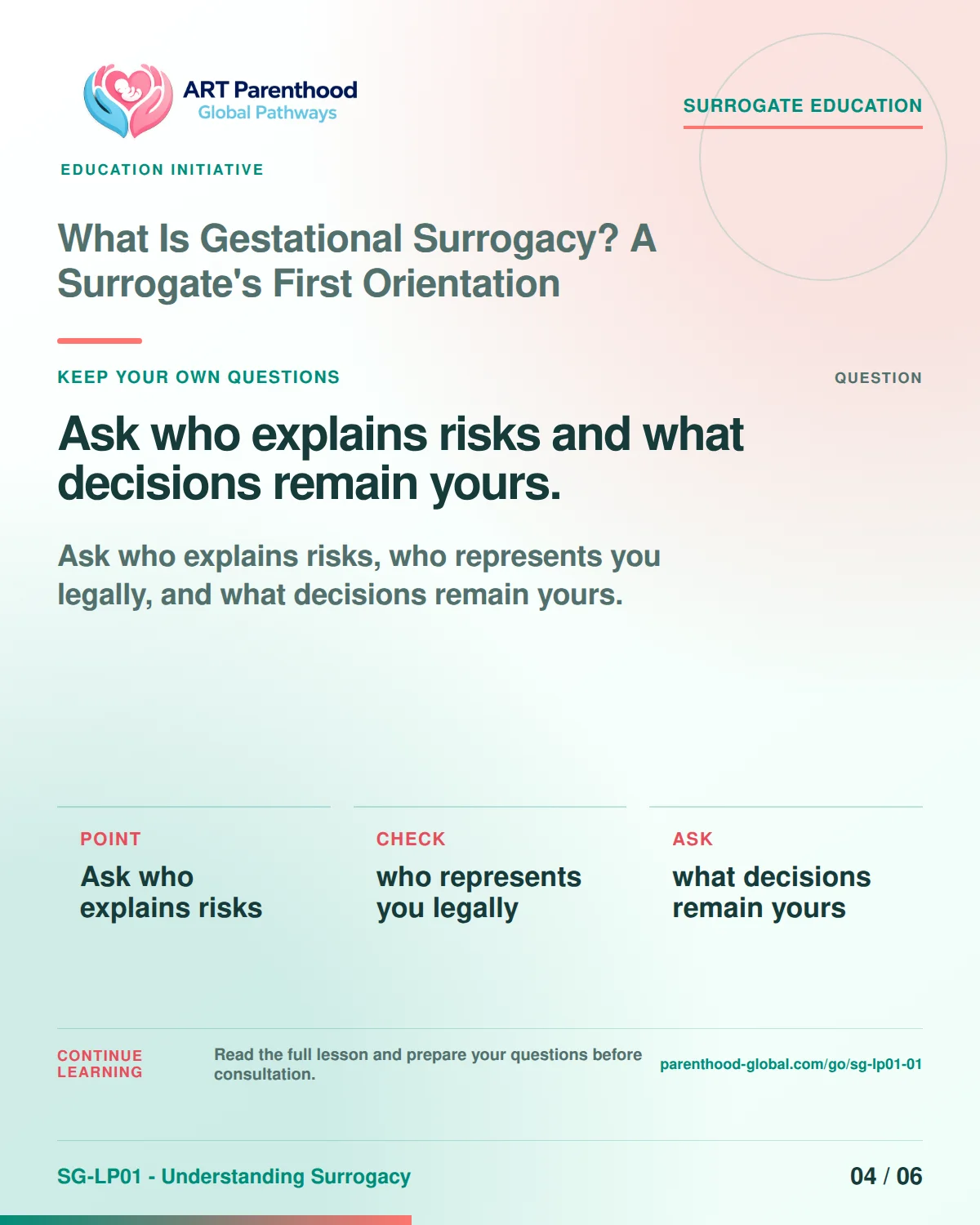
04 / 06Keep your own questions 
05 / 06Country and program rules vary 
06 / 06Learning is not committing
What gestational surrogacy usually means
In gestational surrogacy, a surrogate carries an embryo created through IVF for intended parent or parents. That embryo may have been created with eggs and sperm from intended parents, donors, or a combination, but the surrogate is usually not genetically related to the embryo she carries. This is one reason the term gestational surrogacy is used instead of traditional surrogacy.
That definition matters because it shapes how clinics, agencies, counsellors, and lawyers talk about the process. It also helps explain why medical preparation, consent, and written expectations are such a large part of the journey. Carrying a pregnancy is only one part of the role. The surrounding treatment steps, reviews, and boundaries matter just as much.
- Gestational surrogacy is connected to IVF, not to natural conception.
- The surrogate usually is not genetically related to the embryo.
- A definition alone does not answer questions about safety, consent, legal rights, or emotional readiness.
Why this matters if you are the potential surrogate
If you are the person considering surrogacy, the first important question is not only Can I do this medically. It is also Do I understand what would be asked of me physically, emotionally, legally, and practically. You may need to think about medications, monitoring visits, pregnancy history, time away from work, childcare, travel expectations, privacy, communication with intended parents, and how your own support system feels about the process.
Early education should make you more informed, not more pressured. You are allowed to ask detailed questions before matching, before signing anything, and before agreeing to treatment. You are also allowed to decide that surrogacy is not the right fit for your life. A careful process respects that choice rather than treating hesitation as a problem to overcome.
- Ask what parts of the process are optional, expected, or non-negotiable.
- Ask who explains medical risks and who answers questions after hours.
- Ask what decisions remain yours if a cycle changes, fails, or needs to be delayed.
What a responsible first review may include
A responsible surrogacy path often includes more than one kind of review. Medical teams may ask for a general health history, prior obstetric records, and a uterine assessment to understand whether pregnancy has previously been tolerated well and whether transfer planning makes sense. Programs may also discuss infectious disease screening, medication history, and what previous pregnancies or deliveries suggest about risk, while reminding you that no single record can predict every future outcome.
Psychological consultation is also important because surrogacy involves relationships, expectations, and stress as well as treatment. A mental health professional with third-party reproduction experience may explore motivation, support systems, communication style, comfort with boundaries, and how you think about contact during pregnancy and after birth. On the legal side, independent counsel, written agreement terms, and insurance review help clarify reimbursement, decision-making language, privacy, parentage planning, and what happens if unexpected medical issues arise.
- Common review items include prior obstetric records, uterine evaluation, infectious disease screening, psychological consultation, and insurance review.
- Independent legal counsel matters because the same contract language can affect communication, reimbursement, and parentage expectations differently across jurisdictions.
- Screening can clarify risk categories and practical fit, but it cannot promise an uncomplicated pregnancy or guarantee that every program will make the same decision.
Questions worth carrying into the next conversation
A good next step is to keep your own written question list. That list can help you notice whether a clinic, agency, or legal team gives clear answers or glosses over issues that matter to you. Good education does not remove every uncertainty, but it does make the uncertainty easier to name.
Try listening for whether professionals explain both the purpose and the limit of each step. A careful team will explain what screening can clarify, what a contract can outline, and what still depends on changing medical facts, local law, or your own willingness to proceed.
- What records, screening steps, and consultations are expected before matching or transfer planning?
- Will I have independent legal counsel, and when does legal review happen in relation to medical clearance and contract signing?
- How are insurance, reimbursement, privacy, communication expectations, and decision-making boundaries handled in this program and jurisdiction?
For Nerds: Technical Deep Dive
This advanced layer is for readers who want more than the basic definition of gestational surrogacy. It walks through what surrogate screening is trying to clarify, which records and professionals usually matter, where legal and insurance review fit into the sequence, and why country or state variation can change the meaning of the same step without making one online summary universally reliable.
What screening is actually trying to clarify
Surrogate screening is not one single approval test. It is a layered attempt to understand whether a future pregnancy would be approached with informed expectations, reasonable medical planning, and enough support for the person being asked to carry it. A reproductive endocrinologist or fertility clinician may begin with general medical history, prior pregnancy history, delivery history, and records from earlier prenatal or obstetric care. Those records help a team ask whether previous pregnancies were uncomplicated, whether there were issues such as hypertensive disorders, preterm birth, postpartum complications, or surgical deliveries, and whether those details change how a future transfer discussion should be framed. Uterine review may include imaging or cavity assessment because a transfer plan depends not only on embryo availability but also on whether the uterus appears suitable for preparation and implantation. Infectious disease screening matters because IVF-related treatment and pregnancy planning follow safety protocols for the person carrying the pregnancy, the intended parents, and any clinical staff handling tissue or specimens. Psychological consultation adds a different type of data. It does not function like a lab result, and it should not be treated as a pass-fail personality judgment. Instead, it may clarify how a potential surrogate understands motivation, family support, privacy, contact expectations, stress, prior loss, and comfort with the unusual relational structure of carrying a pregnancy for someone else. The same is true of counselling about medications, monitoring, transfer preparation, and pregnancy expectations. These steps help a program explain what is being asked and what support is available, but they cannot guarantee that a pregnancy will feel emotionally easy or medically uncomplicated. Advanced readers should also notice the expert roles here: reproductive endocrinology interprets medical suitability, obstetric history informs pregnancy-risk discussion, counselling addresses readiness and support, and legal review translates those realities into documents and decision boundaries rather than pretending that one clearance letter settles everything.
- Prior obstetric records can clarify how earlier pregnancies and deliveries went, but they cannot promise that the next pregnancy will follow the same pattern.
- Uterine cavity review, infectious disease screening, and medication counselling are planning checkpoints, not guarantees of implantation or uncomplicated pregnancy.
- Psychological consultation is meant to explore readiness, expectations, and support, not to replace medical judgment or force a person to proceed.
- The key medical reviewers are usually a fertility clinician and, when history is complex, an obstetric or maternal-fetal-medicine voice familiar with pregnancy risk.
Expected ranges / examples
- CDC definition frame: ART involves handling eggs, sperm, or embryos, and gestational surrogacy is typically tied to IVF-created embryos. This is the terminology frame for why gestational surrogacy is discussed as an ART pathway rather than as a conventional pregnancy arrangement. Source: CDC - About ART.
- Screening example set: medical history, pregnancy records, counselling, legal review, and consent discussions. These examples show the kinds of information a responsible program may review before treatment planning, while leaving room for clinic and jurisdiction variation. Source: ReproductiveFacts.org - Third-Party Reproduction.
- Cavity and infection review example: uterine assessment plus infectious screening before transfer-related planning. These examples help explain why screening is broader than one scan or one blood draw and why safety protocols are part of early education. Source: ReproductiveFacts.org - Third-Party Reproduction.
Where legal review, insurance review, and timing enter the pathway
The legal and process side of surrogacy is often where a simple public definition breaks down. A potential surrogate is not only being asked whether she could carry a pregnancy. She is being asked whether she understands how matching, contract review, insurance handling, transfer timing, contact expectations, reimbursement structure, and parentage planning interact. In practice, those items should be sequenced, not blurred together. Independent legal counsel matters because the surrogate and intended parents do not occupy the same legal role, even when everyone is aligned in goodwill. Agreement language may address reimbursement, expenses, privacy, selective reduction or termination language, travel, communication, lost wages where permitted, and what happens if medical recommendations change. Insurance review matters because a health plan may treat surrogacy-related maternity care differently, may require specific disclosures, or may leave gaps that the parties need to understand before treatment starts. Advanced readers should also pay attention to jurisdiction. In the United States, surrogacy law is not one national rule set; state-level law and court practice can change contract enforceability, parentage steps, compensation handling, and what counsel recommends before transfer. In Canada, federal law prohibits paying a surrogate and instead focuses on permitted reimbursement frameworks, which changes both language and recordkeeping expectations around expenses. Those country examples do not tell a reader what is legal in every province, state, or program. They show why generic internet advice is risky. Timeline logic matters for the same reason. Medical clearance, psychological consultation, legal review, insurance confirmation, and embryo-transfer preparation should not be treated as interchangeable boxes that can be checked in any order. A careful process usually moves from education to screening, from screening to match-specific review, from match-specific review to independent legal and insurance work, and only then toward transfer planning if everyone still consents. That sequence protects understanding, not just paperwork.
- Independent legal counsel helps the surrogate review reimbursement, privacy, decision-making language, and parentage expectations from her own position rather than only from the program's position.
- Insurance review is not a side issue because coverage language, exclusions, disclosure rules, and maternity-related costs can materially affect whether a proposed arrangement is workable.
- Country and state variation means the same phrase, such as reasonable expenses or parentage planning, may function differently across jurisdictions.
- Timeline discipline matters because education, screening, legal review, and transfer planning should build on each other rather than being rushed into one meeting or one signature day.
Expected ranges / examples
- Legal workflow example: education, match-specific review, independent counsel, written agreement, then transfer preparation. This example shows a protective sequence rather than a universal legal mandate. Programs and jurisdictions differ, but the order matters for informed consent. Source: ReproductiveFacts.org - Third-Party Reproduction.
- Canadian reimbursement boundary example: payment prohibited; reimbursement framework discussed instead. This example illustrates why compensation language must be reviewed against the governing jurisdiction rather than copied from another country or program. Source: Health Canada - Prohibitions related to surrogacy.
Country / jurisdiction examples
- United States: In the United States, surrogacy rules are handled through state-level legal frameworks rather than one single national rule, so parentage procedure, contract handling, reimbursement language, and insurance strategy can differ materially from one state to another and require local legal review.
- Canada: In Canada, Health Canada states that paying a surrogate is prohibited under the federal framework and the conversation centers on reimbursement of permitted expenses instead, which changes how records, expectations, and legal drafting should be reviewed before any arrangement moves forward.
Timeline breakdown
- Education and self-assessment: Before matching or committing to a program. The potential surrogate learns the basic process, writes down questions, considers family impact, and decides whether to continue exploring rather than being rushed toward immediate commitment.
- Screening and records review: After initial interest and before transfer-specific planning. Medical history, prior obstetric records, uterine review, infectious screening, and counselling may be gathered so the team can discuss suitability, risks, and support needs with more precision.
- Match-specific legal and insurance review: After screening but before treatment steps are locked in. Independent legal counsel, insurance analysis, reimbursement language, privacy expectations, and parentage planning are reviewed in the context of the actual intended-parent match and governing jurisdiction.
- Transfer preparation and consent confirmation: Only after medical, legal, and practical questions are understood well enough to proceed. The clinic can move into medication teaching, transfer preparation, and final consent conversations once the surrogate still wishes to continue and the necessary review steps are complete.
Key takeaways
- Gestational surrogacy usually means carrying an IVF-created embryo for intended parent or parents without a genetic link to the surrogate.
- A responsible surrogacy path includes medical review, counselling, legal support, insurance questions, and clear consent boundaries.
- Learning about surrogacy is not the same as committing to it, and a respectful process leaves room for questions, pauses, and informed choice.
FAQ
Is gestational surrogacy the same as traditional surrogacy?
No. Gestational surrogacy usually means the surrogate carries an embryo created through IVF and is usually not genetically related to that embryo. Traditional surrogacy involves the surrogate's own egg and raises different medical and legal issues.
Does learning about surrogacy mean I am committing to become a surrogate?
No. Education is an early step, not a promise. You can ask questions, request independent advice, pause the process, or decide that surrogacy is not right for you.
Why are legal and insurance questions part of a basic surrogacy lesson?
They matter because reimbursement, privacy, parentage planning, coverage details, and contract timing can shape whether a proposed arrangement is workable and respectful of your boundaries.