

IP-LP01-09 · IP-LP01
Readiness is not constant calm or perfect agreement. It is the ability to notice strain, communicate differences, use support, and pause a decision without treating delay as failure. Infertility, uncertainty, grief, cost, and repeated decisions can affect partners and solo intended parents differently. Practical preparation should include emotional capacity without turning counselling into a worthiness test.
Visual lesson summary
Review the lesson as a carousel.
Swipe or scroll through the key ideas, then continue with the detailed guidance below.
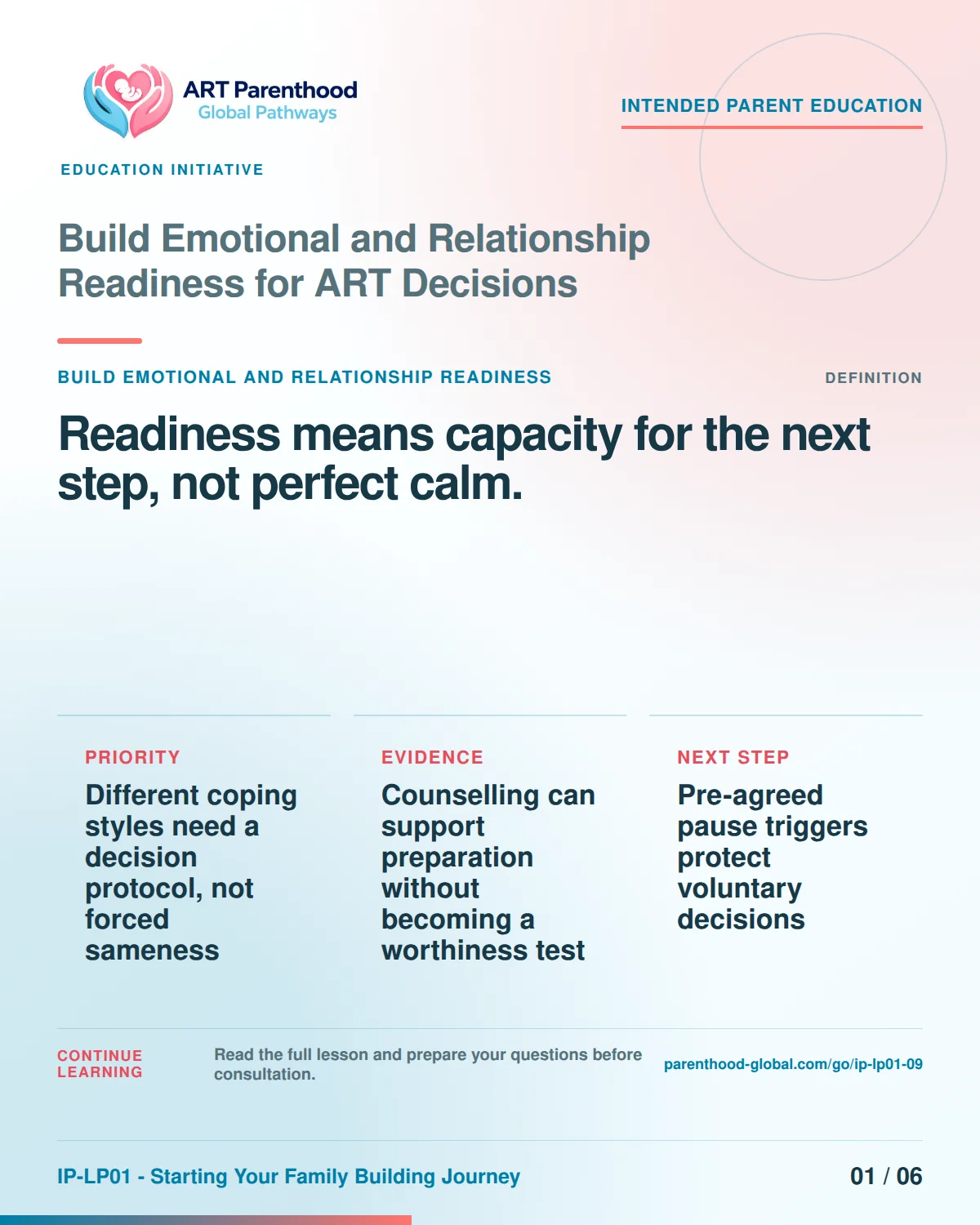
01 / 06Build Emotional and Relationship Readiness 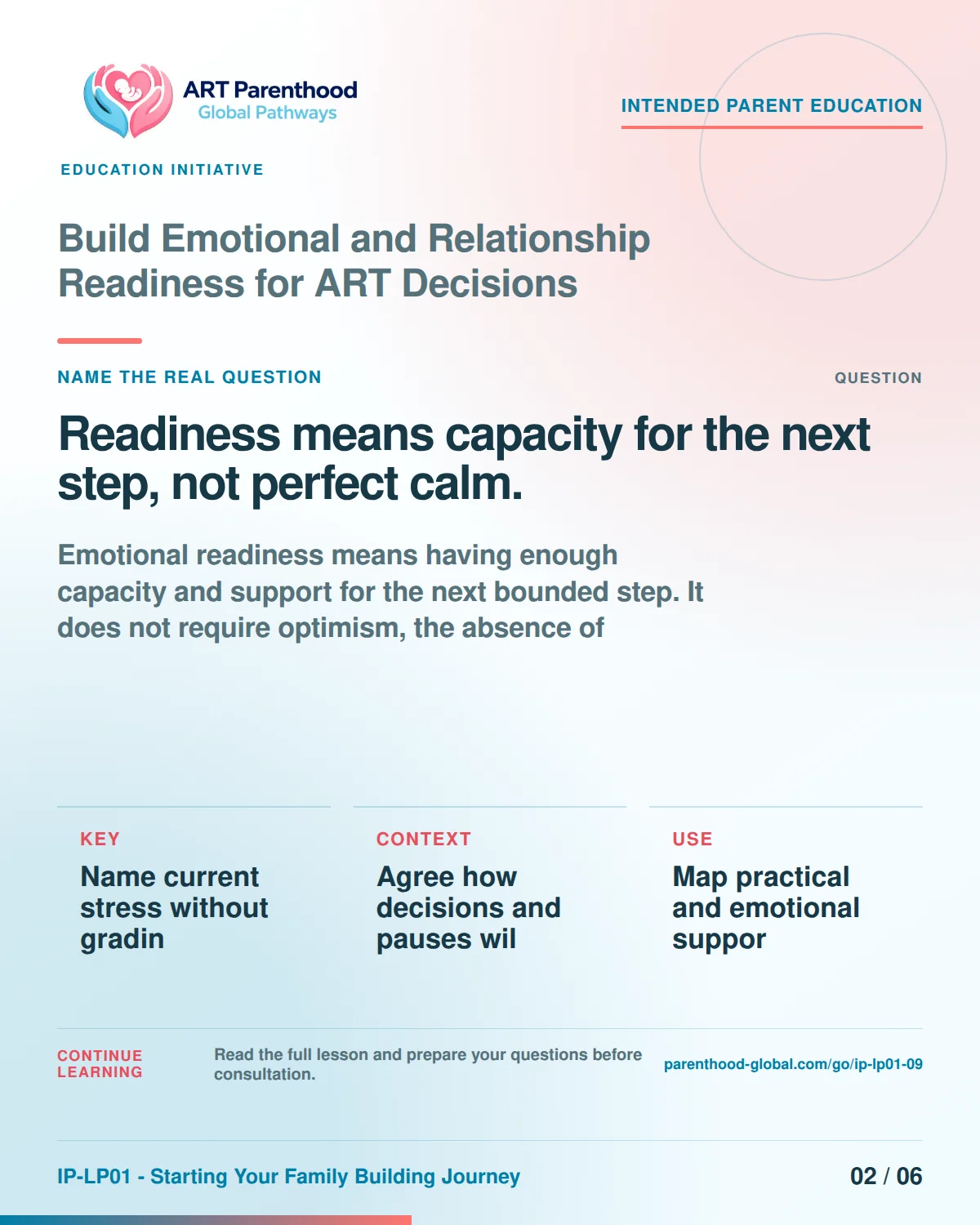
02 / 06Name the real question 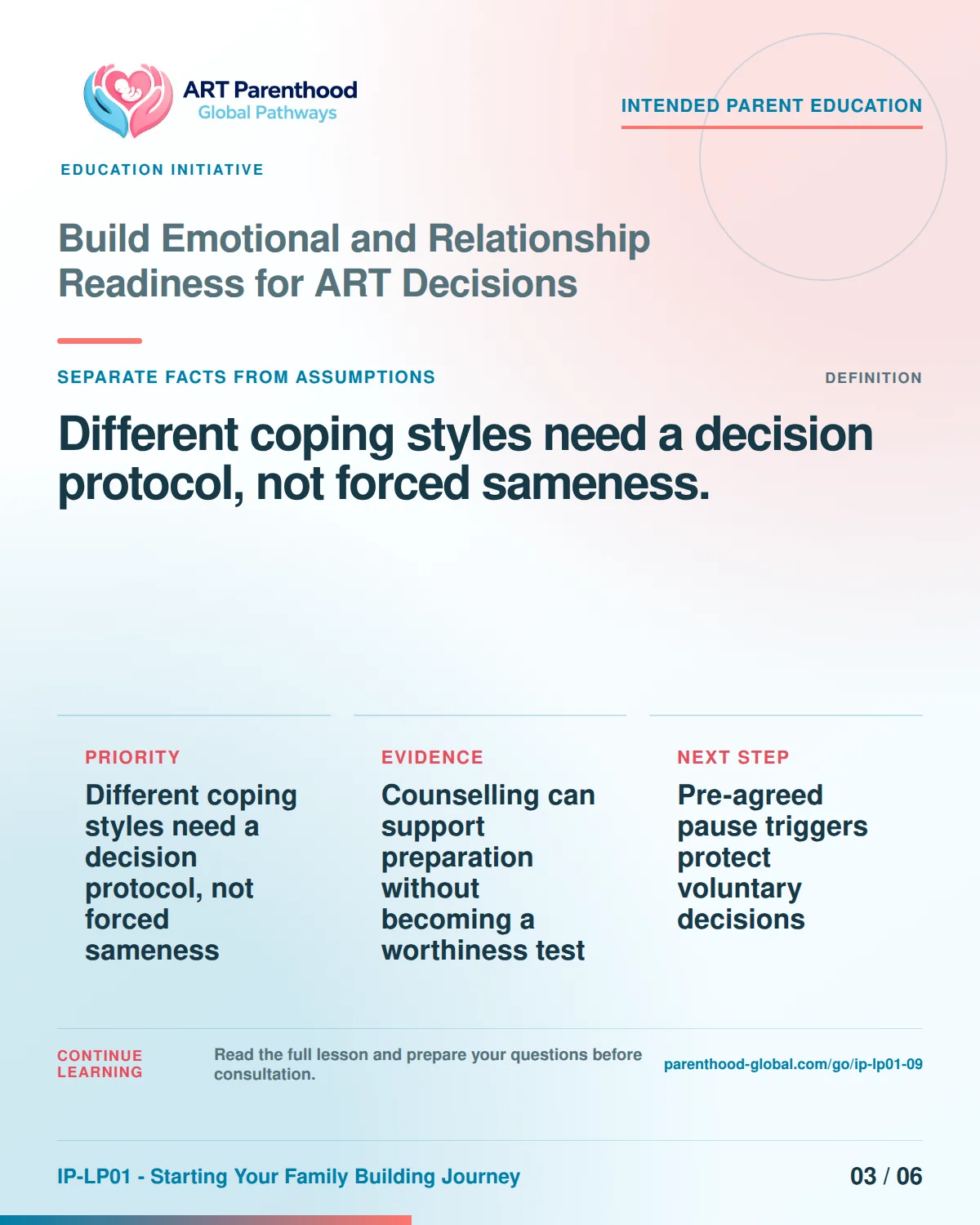
03 / 06Separate facts from assumptions 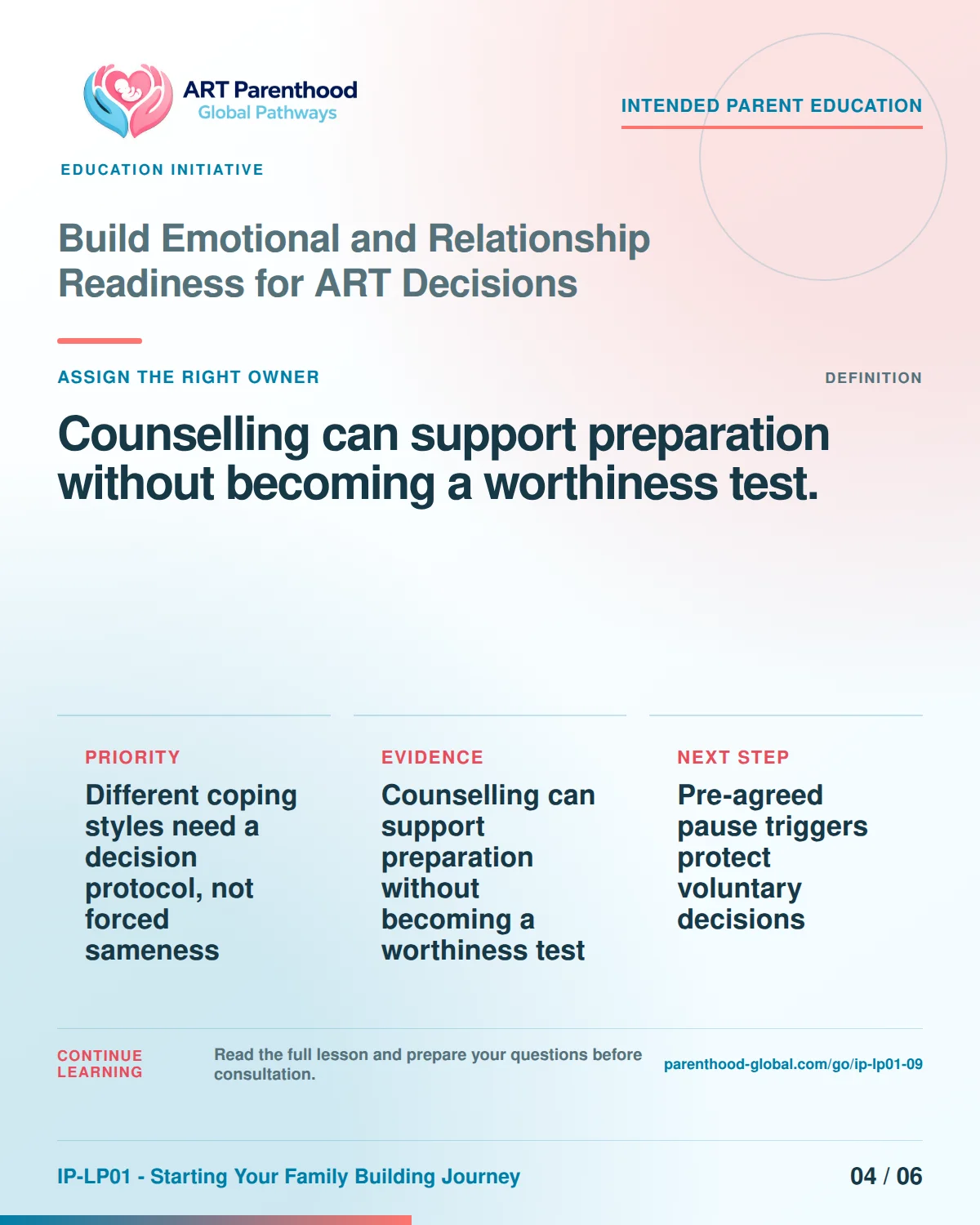
04 / 06Assign the right owner 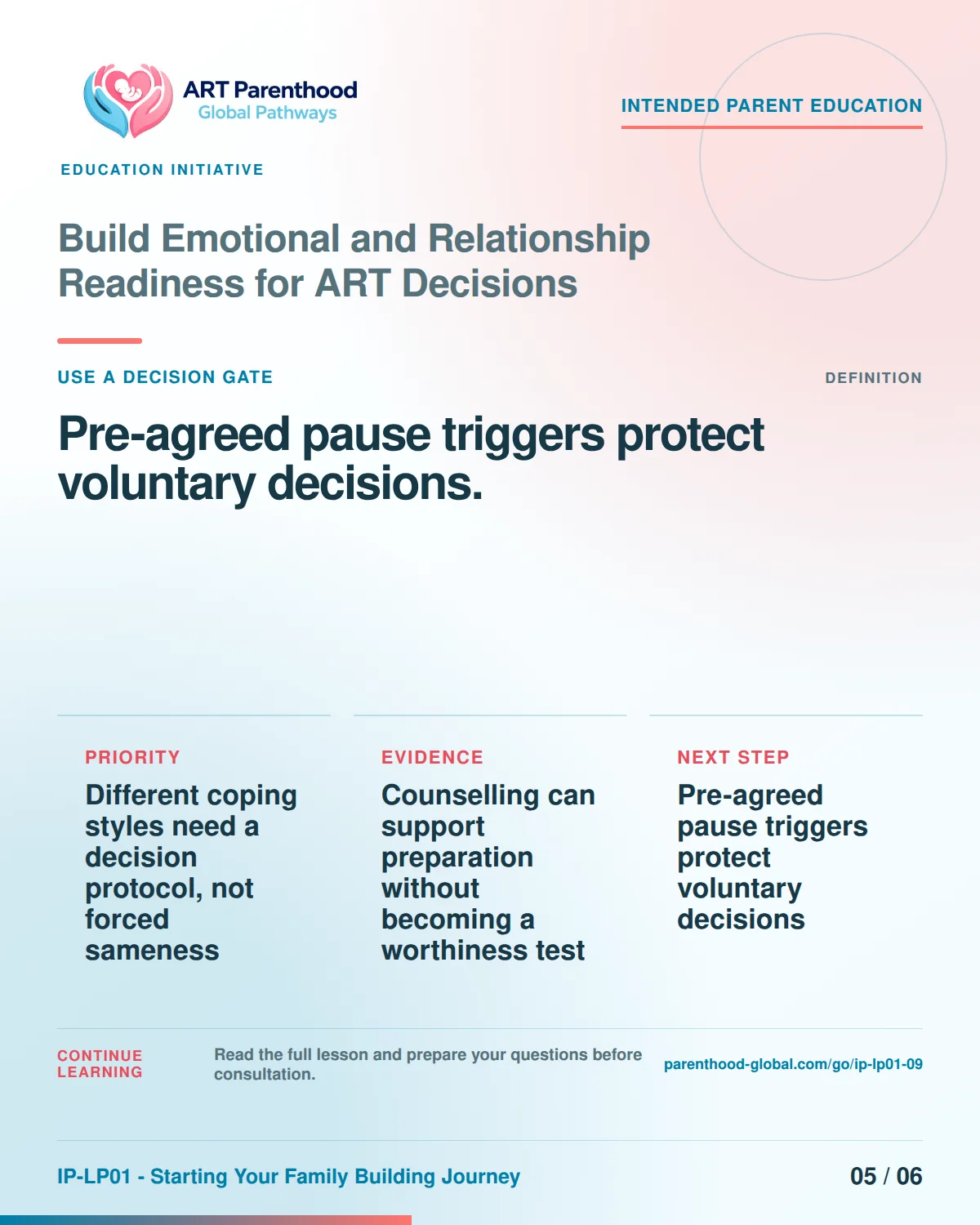
05 / 06Use a decision gate 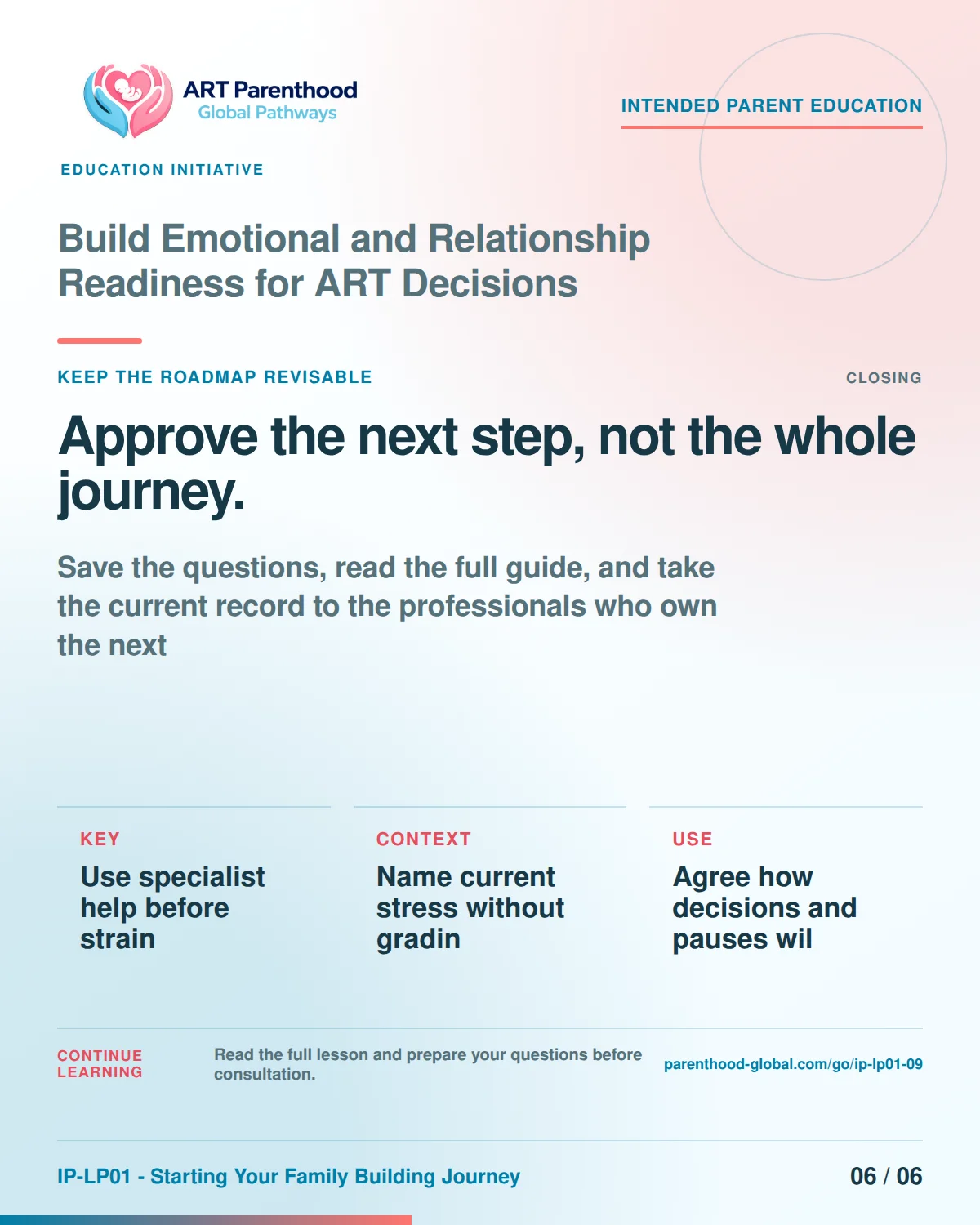
06 / 06Keep the roadmap revisable
What this decision actually contains
Emotional readiness means having enough capacity and support for the next bounded step. It does not require optimism, the absence of grief, or identical reactions between partners. Intended parents may be carrying previous losses, failed treatment, family pressure, identity questions, financial worry, or fear of disclosure. Solo intended parents may have strong autonomy while still needing a dependable practical network. The practical task is to identify how decisions will be made under stress and where support comes from.
Record who owns each question, what evidence supports it, whether it is current, and where it applies. Leave a gap visible until those conditions are met.
- Name current stress without grading it
- Agree how decisions and pauses will work
- Map practical and emotional support people
Why early assumptions become expensive
Unspoken distress can show up as urgent spending, avoidance of information, repeated conflict, secrecy, or agreement given only to end a conversation. One partner may treat another’s request for time as lack of commitment; family members may apply pressure; clinics may need quick administrative answers. These conditions can narrow voluntary choice. Emotional support is also sometimes misused as gatekeeping. A counselling conversation should help people prepare, communicate, and understand implications, not demand a particular emotional performance.
Separate reversible investigation from commitment. Requests for records or independent opinions preserve options; deposits, matching, treatment consent, medication, and non-refundable bookings narrow them. Clear the controlling prerequisite first.
- Mark assumptions explicitly
- Keep reversible steps first
- Delay commitments behind gates
How to work the question in practice
Create a readiness map across six areas: current stress, grief and loss, decision style, partner or support alignment, privacy and disclosure, and daily capacity. For each, record what is manageable, what is strained, what would help, and what triggers a pause. Agree on a decision protocol: when discussions happen, how information is summarized, how either partner can request time, and which decisions require joint agreement. Solo intended parents can nominate a support circle for appointments, recovery, travel, childcare, and moments when decision fatigue is high.
A strong working note contains the exact question, the proposed answer, its source, source date, jurisdiction or clinical context, responsible professional, remaining uncertainty, and next review point. Add the consequence of being wrong. That final field changes behavior: it distinguishes a harmless preference from a blocker that could affect consent, safety, parentage, citizenship, finances, or another participant’s rights.
- Name current stress without grading it
- Agree how decisions and pauses will work
- Map practical and emotional support people
- Identify events that trigger review
- Use specialist help before strain becomes crisis
Decisions and questions to take forward
Decide whether to proceed with the next information-gathering step, widen support, schedule specialist counselling, or pause a material commitment. A pause is especially useful when someone cannot explain the choice in their own words, fears consequences for saying no, or is making a permanent decision to relieve immediate distress. Support can be preventive rather than crisis-driven. Revisit the map after a major result, route change, match, loss, financial change, or relationship shift.
Write the professional’s response in plain language and ask what evidence would change it. If the response depends on a fact that has not been established, mark it conditional. If it depends on another participant’s choice, mark it outside intended-parent control. If it depends on future treatment outcome, treat it as a forecast rather than a promise. The record should make it possible to pause without losing the reasoning already completed.
- How does each person respond to uncertainty or disappointing news?
- Can either of us request time without being punished?
- Which losses or fears are shaping today’s choice?
- Who can provide practical help, not only encouragement?
- What will we share with family now, later, or not at all?
- Which signs mean we pause and seek more support?
What this tool cannot decide
This lesson does not diagnose anxiety, depression, trauma, or relationship problems and is not crisis care. Severe distress, thoughts of self-harm, interpersonal violence, coercion, or inability to function require timely local professional or emergency support. Routine counselling should not be confused with an independent capacity assessment. Intended parents also cannot use their emotional preferences to control a donor’s care, a surrogate’s pregnancy decisions, or another person’s privacy.
Excluded here: mental-health diagnosis or crisis treatment; donor-conception disclosure planning; surrogate relationship management; the pre-commitment capacity review in IP-LP05-06. Route these issues to later lessons or qualified professionals. Unclear consent, safety concerns, pressure, legal contradiction, or uncertain child status should stop the dependent commitment.
- mental-health diagnosis or crisis treatment
- donor-conception disclosure planning
- surrogate relationship management
- the pre-commitment capacity review in IP-LP05-06
Make the next step bounded and revisable
Complete a five-part record: decision under consideration, known facts, missing facts, professional owner, and review trigger. Attach current applicable sources. Note what may proceed while an answer is pending and what must wait, so one bounded step does not silently authorize the whole journey.
Review after a material medical result, route change, new participant, legal opinion, cost change, evidence update, or household shift. Archive the superseded version so the reason for a changed decision remains understandable.
- State the next bounded decision
- Attach current evidence
- Name the accountable owner
- Set a review trigger
- Archive superseded versions
For Nerds: Technical Deep Dive
A technical treatment of evidence provenance, dependency mapping, claim limits, professional accountability, and decision gates for build emotional and relationship readiness for art decisions.
Model the decision as evidence and dependencies
A technically defensible decision record distinguishes source authority, applicability, and freshness. A professional guideline may describe ethical or clinical standards, a regulator may describe licensed-service data, a registry may report outcomes, and an official government page may state an administrative rule. None is interchangeable with an individualized opinion. Record the exact document title, publisher, update date, access date, jurisdiction, and claim supported. Preserve the denominator and endpoint for statistics. For law, preserve the connecting facts that make the rule relevant. For consent, distinguish education, deliberation, authorization, and the continuing right to ask questions or decline. Psychosocial care can be organized by treatment stage because needs and treatment burden change over time. Assessment is not a binary pass-fail event: it can identify information needs, support resources, communication barriers, and risk factors while preserving autonomy. Decision quality improves when options, benefits, harms, uncertainties, and personal values are discussed in a format the person can understand. Documenting a pause trigger before a high-pressure moment is a form of prospective consent protection, not pessimism.
- Separate values, facts, forecasts, and legal prerequisites.
- Record publisher, title, date, jurisdiction, and supported claim.
- Keep another participant’s consent and medical authority outside intended-parent control.
- Use a gate before deposits, matching, treatment, or non-refundable travel.
Timeline breakdown
- Define and classify the question: Before a material commitment. The intended parents separate the value or preference from factual assumptions, forecasts, professional prerequisites, and decisions belonging to another participant.
- Clear the controlling evidence gate: Before the dependent action starts. The accountable professional reviews current applicable evidence, records the interpretation limit, and identifies what would send the decision back for review.
Build an auditable claim and decision register
Operationalize the scope with a claim registry. Each material statement receives a stable claim ID, claim type, supporting source IDs, jurisdiction, reviewer, and interpretation limit. The reader-facing copy should never outrun the registry: if a source supports association, do not write causation; if it reports a population average, do not write an individual forecast; if it describes one country, do not universalize it. Version legal and regulatory claims when rules change and recheck them close to publication. Clinical guidance should use its current version, while psychosocial guidance should be framed as supportive practice rather than a diagnostic verdict. For build emotional and relationship readiness for art decisions, create a dependency table with columns for prerequisite, owner, evidence, status, consequence of failure, and dependent action. Add a rights column when a donor, surrogate, partner, or future child is affected. Add a conflict column when a program or professional may benefit financially from the recommendation. Add an expiry column when screening, quotations, legal advice, or data can become stale. This table is valuable because it makes an apparently simple next step fail safely: the dependent action remains inactive until the controlling evidence is present and reviewed.
- Give every material claim a stable ID and source map.
- Record the consequence if an assumption proves wrong.
- Version changes instead of silently replacing earlier reasoning.
- Recheck jurisdictional and regulatory claims near publication.
Key takeaways
- Readiness means capacity for the next step, not perfect calm.
- Different coping styles need a decision protocol, not forced sameness.
- Counselling can support preparation without becoming a worthiness test.
- Pre-agreed pause triggers protect voluntary decisions.
FAQ
How does each person respond to uncertainty or disappointing news?
Readiness means capacity for the next step, not perfect calm. Record the answer, its professional owner, and what evidence would change it.
Can either of us request time without being punished?
Different coping styles need a decision protocol, not forced sameness. Record the answer, its professional owner, and what evidence would change it.
Which losses or fears are shaping today’s choice?
Counselling can support preparation without becoming a worthiness test. Record the answer, its professional owner, and what evidence would change it.
Who can provide practical help, not only encouragement?
Pre-agreed pause triggers protect voluntary decisions. Record the answer, its professional owner, and what evidence would change it.
What will we share with family now, later, or not at all?
Write the question exactly, identify the responsible professional, and keep the dependent commitment on hold until the answer is current and applicable.
Which signs mean we pause and seek more support?
Write the question exactly, identify the responsible professional, and keep the dependent commitment on hold until the answer is current and applicable.