

ED-LP02-07 · ED-LP02
Demystify psychological assessment while helping donors prepare honest questions about coping, expectations, support, identity, and pressure. Useful education keeps donor autonomy, bodily risk, privacy, practical burden and future implications visible at the same time.
Visual lesson summary
Review the lesson as a carousel.
Swipe or scroll through the key ideas, then continue with the detailed guidance below.
01 / 06Psychological Assessment and Support 
02 / 06Why this matters 
03 / 06How the process should work 
04 / 06How to read the evidence 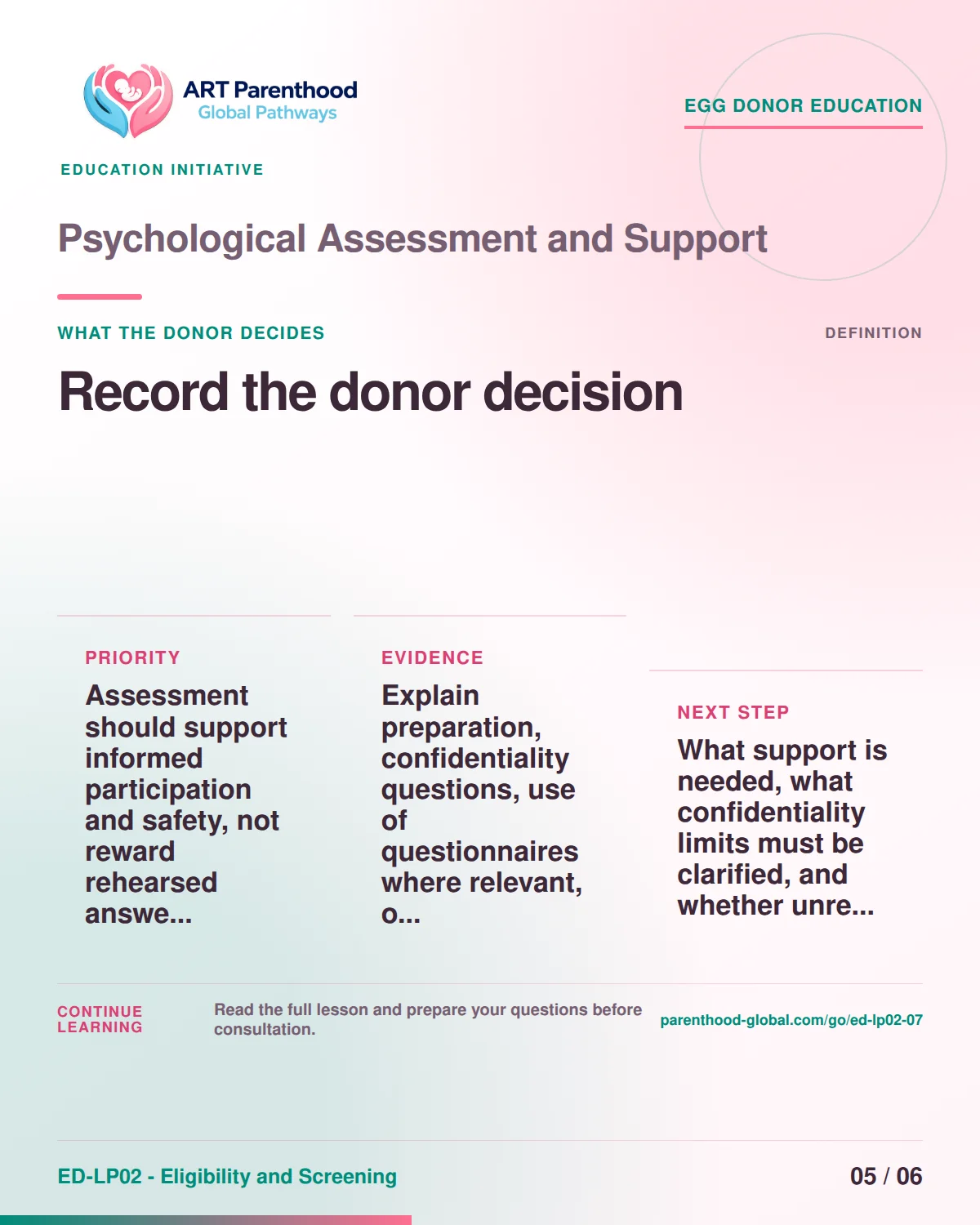
05 / 06What the donor decides 
06 / 06Keep donor choice visible
Keep the donor at the centre
Describe interview topics, readiness and coercion checks, mental-health history, coping, relationships, identity preferences, support, and referral boundaries. The donor remains the person whose health information, body, consent, time and privacy are involved. Program eligibility is not consent, recipient preference is not clinical authority, and compensation does not transfer decision ownership. Start by identifying the exact decision, the donor's options and the professional accountable for explaining the evidence.
For psychological assessment and support, connect assessment, support, and examine to the exact donor decision. Ask privately who created each record, who can see it, what it can establish, what remains uncertain, and whether declining an optional use or pausing participation changes medical care, payment already earned, privacy, or future contact.
Donor checkpoint for psychological assessment and support: obtain the complete interviews, record its date and accountable owner, and keep its interpretation limit beside the next action. If policy or law changes the answer, ask for the named jurisdiction, effective date, and independent review route rather than relying on a verbal summary.
Why this changes informed choice
Assessment should support informed participation and safety, not reward rehearsed answers or imply that mental-health history automatically disqualifies someone. A donor-centred process does not ask whether a reader is cooperative enough to proceed. It asks whether information is complete, pressure is absent, practical burdens are visible and a pause can be expressed without retaliation. Acceptance by one program is not a certificate of health or worth; a decline is not a diagnosis unless an appropriate clinician explains a finding separately.
For psychological assessment and support, connect structured, versus, and screening consent to the exact donor decision. Ask privately who created each record, who can see it, what it can establish, what remains uncertain, and whether declining an optional use or pausing participation changes medical care, payment already earned, privacy, or future contact.
Donor checkpoint for psychological assessment and support: obtain the complete collection date, record its date and accountable owner, and keep its interpretation limit beside the next action. If policy or law changes the answer, ask for the named jurisdiction, effective date, and independent review route rather than relying on a verbal summary.
How the process should be documented
Explain preparation, confidentiality questions, use of questionnaires where relevant, opportunity for private discussion, and routes to independent support. Put the sequence in writing. Record the applicable policy or protocol version, responsible entity, appointment or document, information collected, possible result categories, privacy route, decision point and escalation contact. Separate a clinic's medical role, an agency's coordination role, an independent adviser's role and the donor's continuing participation decision.
Read evidence without overclaiming
Screening evidence for psychological assessment and support should be read as a set of bounded questions, not a verdict on health, fertility, character, or future parenting. Keep psychological, support, examine, structured linked to the original report, method, date, units or categories, and accountable interpreter. A regulatory minimum, clinic threshold, and individualized clinical judgment are different things. Ask what a result changes for this cycle, whether personal follow-up is indicated, what enters the donor's own medical record, and what remains uncertain.
Make risk and escalation usable
For psychological assessment and support, an unexpected screening result needs a humane route, not an automated rejection message. The donor should know who explains the finding, whether confirmatory testing or referral is offered, who pays, what information is shared outside the clinical team, and how an error can be corrected. A pause or program decline must not be framed as donor failure, and participation pressure must not replace informed follow-up.
Protect privacy and future records
For psychological assessment and support, map access to versus, interviews, screening consent, complete source report. Separate information required for safe care from optional profile, research, image, marketing, recontact, or secondary data uses. Record retention, correction, deletion limits, re-identification risk, and future medical-update routes should be visible before consent, with no promise that genomic or linked data will remain permanently anonymous.
Build a decision record
What support is needed, what confidentiality limits must be clarified, and whether unresolved pressure or distress warrants pausing. Make the next step reversible where possible. Keep copies of the relevant forms and answers, mark unresolved questions, name the independent reviewer and define a stopping condition. The following remain outside this lesson: General motivation reflection; Medical eligibility interpretation; Legal consent-document requirements. Route those questions rather than allowing a broad assurance to stand in for clinical, legal, genetic or psychological review.
- What support is needed, what confidentiality limits must be clarified, and whether unresolved pressure or distress warrants pausing.
- Ask who owns the decision and who only advises.
- Request the current document, protocol or policy version.
- Record privacy, cost, escalation and stopping arrangements.
For Nerds: Technical Deep Dive
Examine structured versus clinical interviews, response bias, construct validity, coercion screening, dual-role conflicts, and culturally responsive assessment.
Mechanism, burden and donor safety
A defensible technical record for psychological assessment and support starts with psychological, support, examine, structured, versus, interviews, screening consent, complete source report, collection date, method and unit, program criterion, clinical interpretation. Each item needs a stable claim or document identifier, source authority, date, method or legal basis, applicable population or jurisdiction, accountable interpreter, access rule, and an explicit limit. Examine structured versus clinical interviews, response bias, construct validity, coercion screening, dual-role conflicts, and culturally responsive assessment. The donor-facing implication must remain separate from recruitment, recipient preference, and program convenience. Program eligibility cannot substitute for consent, and a signed consent cannot cure missing risk information, coercion, unclear data use, or an absent escalation route. Evidence review should compare authority, applicability, completeness, conflicts, and uncertainty. Current source set: ASRM donation guidance; ESHRE psychosocial care guideline; ASRM informed consent in assisted reproduction; ACOG informed consent and shared decision making. A professional guideline may describe recommended practice; a regulator may establish a minimum; a clinic policy may be narrower; and a personal clinical or legal opinion depends on individual facts. Do not turn a population association into an individual prediction, a program threshold into a diagnosis, or a jurisdiction example into a universal rule. Record missing denominators, assay or observer variation, sampling limits, selection bias, incomplete follow-up, changing law, and which reviewer must resolve the uncertainty.
- Describe interview topics, readiness and coercion checks, mental-health history, coping, relationships, identity preferences, support, and referral boundaries.
- Explain preparation, confidentiality questions, use of questionnaires where relevant, opportunity for private discussion, and routes to independent support.
- What support is needed, what confidentiality limits must be clarified, and whether unresolved pressure or distress warrants pausing.
Expected ranges / examples
- Donor decision sequence: psychological -> assessment -> support -> describe -> interview. A non-numeric example showing why screening, consent, treatment and outcome labels must remain distinct. Source: ASRM donation guidance.
Measures, policies and uncertainty
Operationalize autonomy with a responsibility matrix and a stop-point log. The donor controls participation and personal consent; clinicians control diagnosis and treatment recommendations; laboratories control validated methods and reports; genetic professionals interpret genetic findings; independent counsel advises the donor on legal consequences; and coordinators manage handoffs without absorbing those authorities. Record which action is optional, what happens after a pause or withdrawal, what care and payment remain due, how privacy is protected, and who handles urgent and non-urgent concerns. Compensation must never be described as purchasing eggs, compliance, medical risk, silence, identity rights, or future contact. What support is needed, what confidentiality limits must be clarified, and whether unresolved pressure or distress warrants pausing. Build the decision record with the exact question, supporting records, unresolved conditions, professional owner, source date, donor preference, other participants' separate rights, and a trigger to proceed, proceed conditionally, pause, seek review, or stop. Test the proposed action against the exclusions: General motivation reflection; Medical eligibility interpretation; Legal consent-document requirements. Those boundaries prevent this package from drifting into diagnosis, prescribing, contract drafting, outcome prediction, or relationship promises. The technical layer supports better questions; it does not make the decision for the donor.
- Describe interview topics, readiness and coercion checks, mental-health history, coping, relationships, identity preferences, support, and referral boundaries.
- Explain preparation, confidentiality questions, use of questionnaires where relevant, opportunity for private discussion, and routes to independent support.
- What support is needed, what confidentiality limits must be clarified, and whether unresolved pressure or distress warrants pausing.
Expected ranges / examples
- Donor decision sequence: assessment -> support -> describe -> interview -> topics. A non-numeric example showing why screening, consent, treatment and outcome labels must remain distinct. Source: ASRM donation guidance.
Consent, privacy and decision limits
Evidence review should compare authority, applicability, completeness, conflicts, and uncertainty. Current source set: ASRM donation guidance; ESHRE psychosocial care guideline; ASRM informed consent in assisted reproduction; ACOG informed consent and shared decision making. A professional guideline may describe recommended practice; a regulator may establish a minimum; a clinic policy may be narrower; and a personal clinical or legal opinion depends on individual facts. Do not turn a population association into an individual prediction, a program threshold into a diagnosis, or a jurisdiction example into a universal rule. Record missing denominators, assay or observer variation, sampling limits, selection bias, incomplete follow-up, changing law, and which reviewer must resolve the uncertainty. What support is needed, what confidentiality limits must be clarified, and whether unresolved pressure or distress warrants pausing. Build the decision record with the exact question, supporting records, unresolved conditions, professional owner, source date, donor preference, other participants' separate rights, and a trigger to proceed, proceed conditionally, pause, seek review, or stop. Test the proposed action against the exclusions: General motivation reflection; Medical eligibility interpretation; Legal consent-document requirements. Those boundaries prevent this package from drifting into diagnosis, prescribing, contract drafting, outcome prediction, or relationship promises. The technical layer supports better questions; it does not make the decision for the donor.
- Describe interview topics, readiness and coercion checks, mental-health history, coping, relationships, identity preferences, support, and referral boundaries.
- Explain preparation, confidentiality questions, use of questionnaires where relevant, opportunity for private discussion, and routes to independent support.
- What support is needed, what confidentiality limits must be clarified, and whether unresolved pressure or distress warrants pausing.
Key takeaways
- Describe interview topics, readiness and coercion checks, mental-health history, coping, relationships, identity preferences, support, and referral boundaries.
- Assessment should support informed participation and safety, not reward rehearsed answers or imply that mental-health history automatically disqualifies someone.
- What support is needed, what confidentiality limits must be clarified, and whether unresolved pressure or distress warrants pausing.
- A donor can ask questions, seek independent advice, pause or decline without being reduced to a program outcome.
FAQ
What does psychological assessment and support mean for a donor?
Describe interview topics, readiness and coercion checks, mental-health history, coping, relationships, identity preferences, support, and referral boundaries.
Why does this matter before proceeding?
Assessment should support informed participation and safety, not reward rehearsed answers or imply that mental-health history automatically disqualifies someone.
How should the process work?
Explain preparation, confidentiality questions, use of questionnaires where relevant, opportunity for private discussion, and routes to independent support.
Can a program decision replace my consent?
No. Eligibility, coordination and clinical recommendations are different from the donor’s voluntary and continuing participation decision.
Which review lenses are required?
The approved scope requires editorial, psychological; each reviewer owns a distinct accuracy and safety question.
What should I record before deciding?
What support is needed, what confidentiality limits must be clarified, and whether unresolved pressure or distress warrants pausing.